
















Standing on what should have been a thriving yam field, Doofan Tertsegha scanned the empty ridges stretching across her farm. The soil had been prepared carefully. The yam seedlings had been planted at the first signs of rain, just as she had done for years. But weeks of unexpected dry weather left almost everything dead.
“As you can see, this is my farm where I planted yams at the onset of rain,” the mother of nine said quietly, pointing across the field. “If you look very well, it looks as if I didn’t plant anything at all. All my seedlings died.”
She planted yam seedlings on 70 lines ridges. Only twenty lines survived.
“I lost 50 lines,” she said.

For Ms Tertsegha, who has spent more than a decade farming in Benue State, the losses extend far beyond a failed harvest. Every planting season determines whether her children will remain in school, whether there will be enough food at home, and whether the family can meet its most basic needs.
“I have been having sleepless nights, wondering where to even get a loan from,” she said. “How will I pay my children’s school fees now? How will I feed my children? Will I go around begging to feed my children?”
Like thousands of smallholder farmers across Benue, often called Nigeria’s food basket, Tertsegha says increasingly unpredictable rainfall is making farming more uncertain each year. Many farmers also complain that they receive little or no government support when crops fail.
Living from the Farm
Before the recent losses, farming had provided almost everything Tertsegha’s family needed.
She cultivates yams, sesame, maize and sweet potatoes, relying on proceeds from the harvest to pay school fees and other household expenses.

“I feed from the produce of the farm,” she said. “I also sell and pay my children’s school fees and meet other basic needs. I have a large household with over nine people. If I were to buy food, how would I cope?”
Even during difficult periods, she said, the farm has always offered some measure of security.
That confidence is beginning to fade.
Changing Seasons
She said rainfall patterns have changed noticeably since she began farming.
“When I started farming, whenever the rains returned, there were hardly any interruptions,” she recalled. “It used to stop exactly when we expected it to. But over the years, I started noticing changes.”
Sometimes the rains arrive early but stop suddenly. In other years, they begin late and continue well beyond the usual farming calendar, affecting crops that depend on predictable weather.
Her worst experience came in 2022. She planted sesame across one-third of her farmland, expecting a normal rainy season. Instead, the rains ended early.
“The crops could not produce seeds,” she said. “I totally lost that year. I did not even harvest a grain.”
The financial consequences lingered long after the season ended.
“I thought I would use the money from sales to meet some basic needs. I was not expecting to lose, both the capital and gain nothing.”
A Difficult Choice
For many farmers, waiting for consistent rainfall before planting is no longer an option.
According to Ms Tertsegha delaying planting often means missing the short growing period required for many crops.
“If you wait to be sure of the rainfall, then you will lose totally,” she said. “It has become more difficult to know when to plant.”
Last year, she planted maize, but the crop produced far below expectations because the rains ended too soon.
Other crops, including groundnuts, soybeans and bambara nuts, have also been affected.
Holding On
Despite repeated losses, Ms Tertsegha has refused to reduce the size of her farm.
“As a farmer, I know that it is worth the effort,” she said. “Everything is a risk. Some seasons I get plenty of yields. Other years I lose. So I continue with the same size.”
Still, she admits the uncertainty has reduced her income.
“Mostly, it is during selling that I am affected because buyers usually want premium quality crops,” she said.
Poor harvests have also increased production costs.
“When crop prices go up, those who make ridges or clear farms also increase the amount they charge.”
“Where Is the Support?”
Although she has heard of government agricultural programmes, Ms Tertsegha said she has never personally received training, grants or farming support.
“If the government can support me with fertilizers, herbicides or any aid, I will be grateful,” she said.
She acknowledged that the Benue State Government introduced a fertilizer subsidy programme last year but alleged that many ordinary farmers did not fully benefit because middlemen inflated prices.
“They embezzle or increase the prices for their personal gains,” she alleged.
“I Don’t See a Future”
Another farmer, Secivir Kase, shares many of the same concerns.

Speaking with our correspondent, she said she has never received a loan from the Bank of Agriculture despite years of farming.
“I have never benefited, so I cannot comment,” she said when asked about government support. “Even when I experienced total loss, I did not get any support.”
She described 2022 as her most difficult farming season because of prolonged dry weather.
Yet she continues farming because she has few alternatives.
“This is my only source of livelihood,” she said. “If I stop, where would I get money to meet my basic needs?”
Kase believes the government should prioritise subsidies for fertilizers, herbicides and farming equipment.
Without stronger support, she fears commercial farming in Benue could steadily decline.
“As it is going, I don’t see a future for farming in Benue State,” he said. “Many people may stop farming commercially and only produce enough for their families.”
Waiting for Promises
For Simon Shuur, farming has been a way of life for more than 30 years.
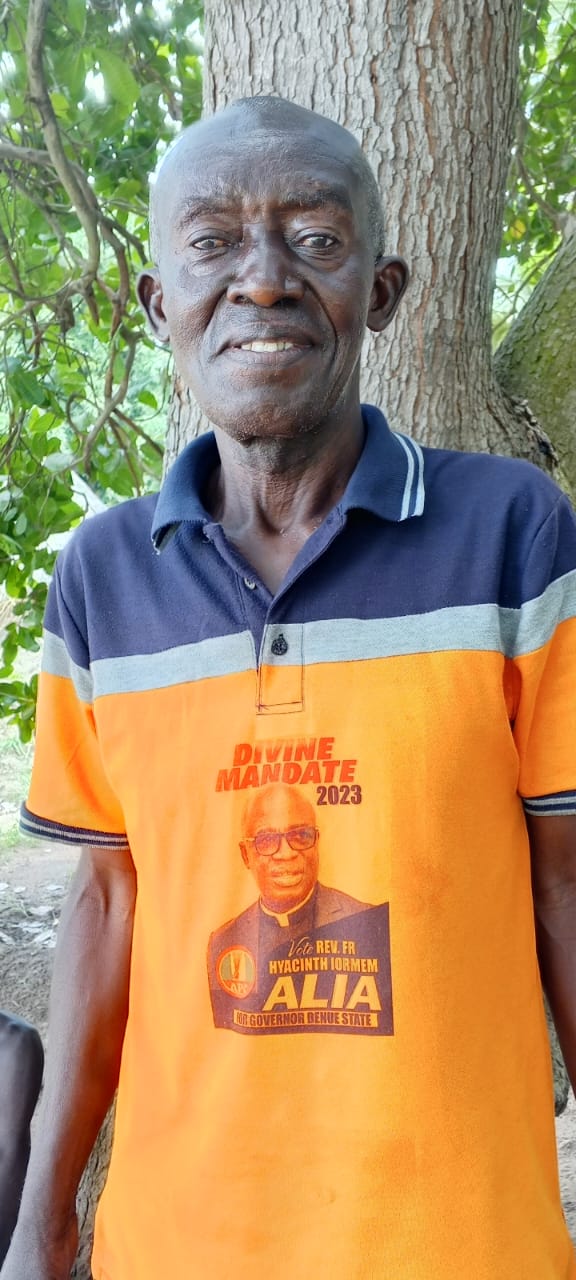
Each season he plants yams, cassava, maize and rice to feed his family.
Today, he says the greatest challenge is no longer pests or poor soils but increasingly unpredictable weather.
“The unpredictable rainfall pattern has affected almost all crops,” he said.
Unlike in the past, he now prepares his land and waits for sustained rainfall before planting.
“If we plant before the rains return and they delay, the seedlings rot,” he explained.
He recalled that farmers once considered April a late period for planting yams.
“This year, people were planting yams at the end of May,” he said. “Twenty years ago, no farmer planted yams in May.”
Despite losing maize, rice and nearly a hectare of cassava in previous seasons, Shuur continues to expand rather than reduce his farmland.
“This is the work I do,” he said. “Whether there is loss or not, I cannot stop.”
Like many others, he said government promises have brought little practical support.
“Some people came and wrote our names down,” he recalled. “Others came, took photographs and promised support. Until today, I have heard nothing.”
For now, farmers like Mtseva continue to plant, not because the risks have disappeared, but because they have little choice.
Standing beside the few yam plants that survived weeks of dry weather, she expressed the hope that keeps many smallholder farmers returning to their fields every season.
“As I am seeing you,” she said, “I see hope, and I believe that God will help me through you.”
Fifty Years on the Farm, Benjamin Agwa Says He Would Quit if He Could
For more than 50 years, Benjamin Agwa has measured time by planting seasons.
The Benue farmer has spent most of his life cultivating rice, maize, groundnuts, yams and cassava. The harvests paid his children’s school fees, fed his household and kept him on the land year after year.
Now, after five decades in the fields, he says farming has become a struggle he can no longer predict.
“If I had another option, I would have stopped farming,” Agwa told our correspondent. “But I have no choice.”
Like many farmers interviewed across Benue State, Agwa says the greatest challenge is no longer pests or poor soils. It is the weather itself.
“There has been a shift in the pattern of rainfall,” he said. “The rains now start late and sometimes stop earlier than they used to.”
The changing seasons have altered what he plants and when he plants it. Yams have largely survived because they require less water, he said, but maize and groundnuts have suffered repeated losses.
“When groundnuts are ready for harvest, they sometimes begin germinating in the soil. Maize is also badly affected,” he said.
Despite the uncertainty, Agwa has never reduced the size of his farm.
Instead, he spreads the risk by planting cassava alongside other crops and leaving exhausted plots to recover before cultivating them again.
“It is from this farm that I pay my children’s school fees,” he said. “Farmers continue because we hope the next season will be better.”
Like several other farmers interviewed for this report, Agwa said he has never received assistance despite repeated promises.
“Some years ago, people came, took pictures of us and our farms, but nothing followed,” he said. “I would have loved government support with fertiliser and herbicides. Fertiliser makes a great difference, especially after drought.”
Unlike some communities where young people are leaving agriculture, Agwa said many youths around him still farm because they have few alternatives.
“I Eat From My Farm”
For Ngoandu Iornenge, farming remains more than an occupation.

It is the reason her family eats.
For over a decade, she has cultivated cassava, sweet potatoes and maize on rain-fed farmland in Benue.
“If not for farming, we would have gone back to the village,” she said. “We feed from this farm instead of buying food. We eat to our satisfaction.”
Like other farmers, Iornenge has watched the seasons become harder to read.
“Some years the rains start early. Other years they come late,” she said. “This year we experienced dry weeks after the rains began.”
Those dry weeks delayed planting and reduced maize yields.
“Before now, by this time our maize would already be growing very well,” she said. “This year we only just planted.”
She still depends largely on knowledge passed down through generations rather than official weather forecasts.
“I rely on the traditional methods of our forefathers and the onset of rains,” she said.
Although her farm suffered losses, she has not reduced its size.
“The realities in the market always push me back to the farm,” she said. “There is no money to buy food, so it is better to plant it yourself.”
She recalled receiving subsidised farm inputs through a state programme last year, although she said middlemen inflated prices and many farmers still struggled to obtain supplies.
Even so, she believes agriculture still has a future in Benue.
“I am hopeful,” she said. “The governor has established processing factories, and I believe more opportunities will come.”
Farming Without a Calendar
For Fidelia Iyoo, chairperson of the Glogsadi Women Multipurpose Cooperative, climate change has erased the farming calendar her members once depended on.

The cooperative has 57 women cultivating crops including cassava, ginger, soybeans, sesame and groundnuts.
“The weather is unpredictable,” she said.
“In the past, people knew when to clear land and when to plant. Now we farm as we see, farm as we go.”
The women cultivate together on shared fields, including an 18-hectare ginger project.
Waiting for perfect conditions is no longer an option.
“Sometimes you expect rain and it doesn’t come,” Iyoo said. “That is the risk we take now.”
Government Says It Is Responding
Benue State’s Ministry of Agriculture acknowledges that climate variability is becoming one of the biggest threats facing farmers.

Dav Raphael, an official involved in climate resilience programmes at the ministry, said the state now works with the Nigerian Meteorological Agency (NiMet) to obtain seasonal forecasts through its Planning, Research and Statistics Department, while extension officers are expected to relay information to farmers across the state.
He argued that today’s challenges are the result of decades of environmental degradation.
“Climate change did not happen overnight,” he said. “Deforestation, carbon emissions and indiscriminate use of synthetic materials over many years have brought us to where we are.”
Raphael said the government is promoting what it calls organised farming, linking farmers with finance and guaranteed buyers through initiatives such as the Benue Produce to Lagos project.
He also said the state is encouraging greater use of organic fertilisers to restore degraded soils.
“When we neglected nature and relied more on chemicals, we also lost soil vitality,” he said. “We need to return to practices that work with nature.”
However, when asked about compensation for farmers who suffered heavy crop losses, he did not outline any direct relief programme.
What the Science Shows
The experiences shared by farmers across Benue closely match what climate scientists have observed.
Professor Enoch Terlumun Iortyom, a seasoned Geographer said long-term records across the Guinea Savannah show that the problem is no longer simply how much rain falls, but when it falls.
“We are seeing delayed onset of the rainy season, prolonged dry spells within the rainy season and more intense rainfall events,” he said.
Annual rainfall totals may not have changed dramatically, he explained, but the distribution has become increasingly erratic.

That has profound consequences for agriculture.

Delayed planting, dry spells during flowering and sudden flooding can all reduce yields, forcing farmers to replant and increasing production costs.
Professor Iortyom also said traditional weather indicators, while still valuable, are becoming less reliable on their own because rising temperatures have altered the environmental signals farmers once depended on.
He urged farmers to combine indigenous knowledge with seasonal forecasts issued by NiMet and adopt climate-smart farming practices such as conservation agriculture, drought-tolerant crop varieties, water harvesting and agroforestry.
Without adaptation, he warned, rain-fed agriculture across Benue will become increasingly uncertain over the next two decades.
Between Hope and Uncertainty
Across the communities visited for this report, farmers described different experiences and different coping strategies.
Some trust traditional knowledge. Others are willing to embrace scientific forecasts. Some believe government support is improving, while many say they have never received any assistance despite repeated promises.
Yet one theme remained remarkably consistent.
None of those interviewed said they planned to abandon farming entirely.
For Doofan Tertsegha, who lost 50 lines of yam seedlings to dry weeks, the farm is still the only way to feed nine people.
For Benjamin Agwa, there is simply no alternative after 50 years on the land.
For Ngoandu Iornenge, the farm remains the family’s kitchen.
And for the women of Glogsadi Cooperative, the seasons may have changed, but the work continues.
Benue is still known as Nigeria’s food basket. Whether it can keep that title may depend less on the amount of rain that falls than on whether farmers receive the information, support and resources needed to adapt to rains that no longer follow the rules they once knew.
This report was commissioned with support from the Centre for Journalism Innovation and Development (CJID).
Support Independent Journalism
We appeal to you to donate and support our journalism. The impact of our investigations has given hope to the vulnerable, held power accountable, and become a voice for the oppressed.
Be part of the accountability journey.