
























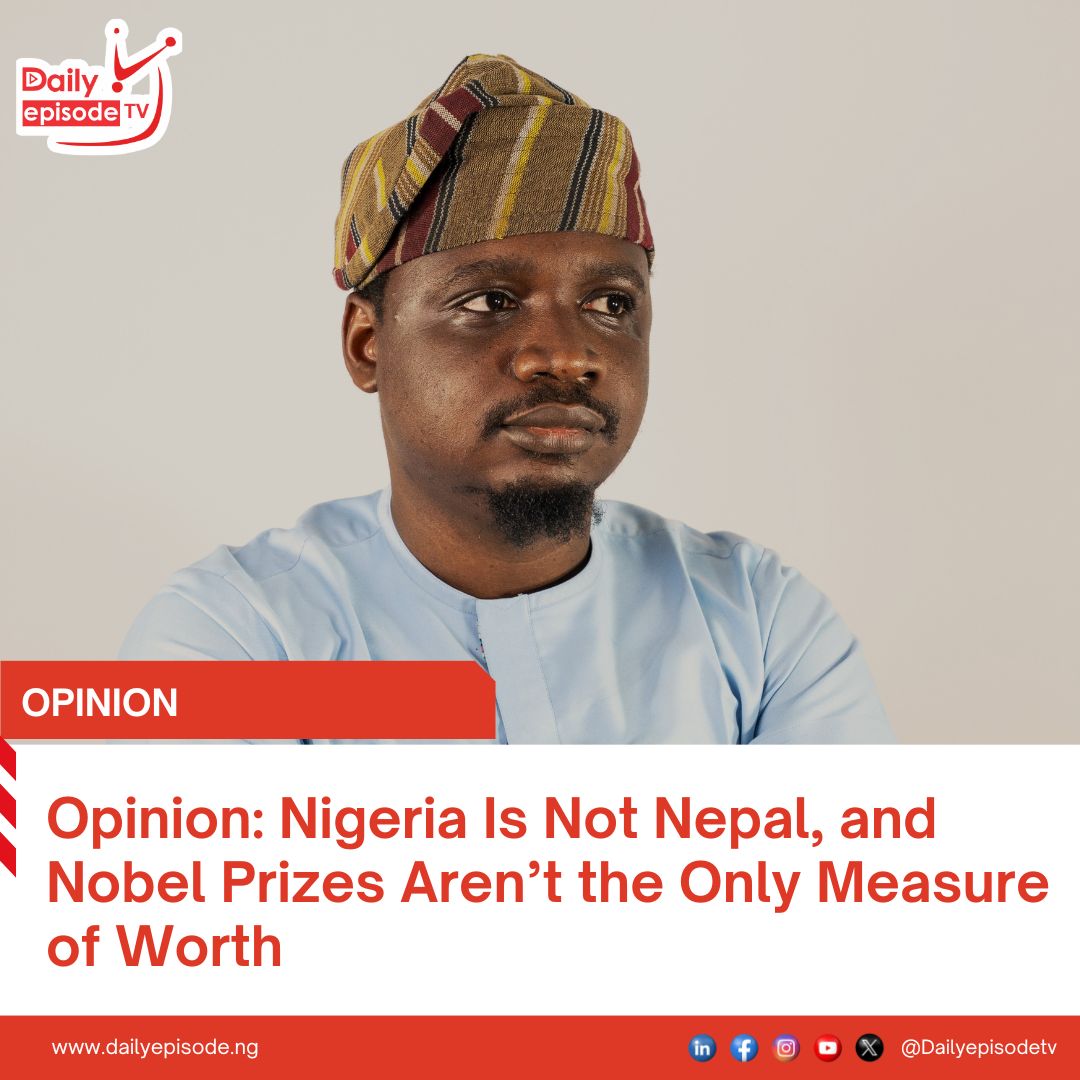

By Adetimilehin Inioluwa Victor (Vic’Adex)
On Hilda Baci’s Jollof world record, a viral post mocked Nigerians: while other countries were winning Nobel Prizes, it claimed, Nigerians were “cooking rice.” On the surface, it sounded like clever social critique. Look closer, and it was a lazy contrast that reduced a country of 220 million into a caricature.
The Illusion of Nobel Parity
Since 1901, fewer than 1,000 individuals have won Nobel Prizes. Even in nations with the most laureates, these winners represent a statistical sliver. To judge a country’s seriousness by Nobel medals is like judging a family’s worth by how many astronauts it has produced. It makes a good rhetorical punch, but it is a lazy misrepresentation of reality.

The Contributions We Miss
Nigeria may not have a parade of Nobel laureates in the sciences, but it has made global contributions that are harder to ignore:
- Finance: Near-instant bank transfers and fintech giants like Flutterwave, Paystack, and Moniepoint have transformed transactions in Africa.
- Health: Maternal risk stratification, sickle-cell therapies, and task-shifting models that are now replicated in other countries.
- Culture: Afrobeats, Nollywood, and Nigerian fashion are shaping global identity far beyond West Africa.
- Science & Tech diaspora: From AI research to medical breakthroughs, Nigerians abroad lead innovations even when the credit accrues elsewhere.
The notion that Nigerian youth waste their energy on trivial pursuits like Guinness records also misses the mark. One can cheer Hilda Baci’s Jollof marathon and still be a coder, activist, or entrepreneur. Cultural celebration and civic seriousness are not mutually exclusive.
In a country reeling from poverty and insecurity, it is easy for cultural spectacle to feel like escapism. But beneath that perception sits a false hierarchy, one that places STEM above the humanities, as though science and technology alone enrich human life. Chinua Achebe’s novels reshaped how the world understood Africa. Fela Kuti’s music became a soundtrack for protest and joy alike. Afrobeats today moves bodies across continents in ways algorithms never could. Culture, like technology, is an engine of human flourishing. To dismiss Jollof or Guinness records as unserious is to miss that they, too, are forms of ambition, discipline, and excellence.
Nepal Is Not Nigeria — and the Arab Spring Shows Why
Some have pointed to Nepal’s youth as an example, celebrating their role in unseating corrupt leaders. But Nepal is a country of 30 million, barely 1.5 times the size of Lagos. Mobilising a subsect of 30 million is not the same as mobilising a subsect of 220 million across a vast, federal state with entrenched divisions and a heavily resourced security apparatus.
A better comparison is the Arab uprisings. In Tunisia, smaller, centralised, and less militarised, protests swiftly toppled a regime. In Egypt, larger, polarised, and dominated by a powerful army, millions filled Tahrir Square, but the old order soon reasserted itself. Nigeria resembles Egypt more than Nepal. The obstacle is not willpower, but weight: entrenched elites, wealth concentrated in the state, and security forces seasoned by insurgencies and trained to crush dissent.
Division as a Mobilisation Barrier
Size matters. But even more, division matters. Mobilising Nigerian youth means bridging nearly every fracture line imaginable:
- Ethnicity: Hausa, Yoruba, Igbo, Tiv, Fulani, Ijaw, and hundreds more, each with layered histories.
- Religion: Christianity and Islam in constant tension, plus divisions within.
- Region: North versus South, Middle Belt complexities, Niger Delta grievances.
- Class: An elite that lives behind gates, a struggling middle class, and millions in informal street economies.
- Education: A deep gulf between those in formal schooling and those locked out.
- Civil war memory: The scars of Biafra remain a haunting backdrop to calls for unity.
- Ideology & Politics: Old-guard party machines versus fragile youth movements fractured by mistrust and fatigue.
These are not abstractions; they are live fault lines that the status quo exploits to scatter movements before they reach critical mass.
The lesson is global. Even in the United States, despite wealth and democracy, deep polarisation across race, class, and ideology has paralysed reform. And at the extreme end, Rwanda’s genocide showed how quickly fault lines, if weaponised, can turn disagreement into catastrophe. Nigeria may not be Rwanda, but the warning is clear. Division is not a demographic footnote. It is the central barrier to collective action.
Holding the Tension
It would be easy to stop at defensiveness, to say Nigerians are indeed serious, full stop. But the truth is more complicated. There are structural barriers that weigh down even the most focused youth. An underfunded education system leaves millions without quality schooling. Insecurity drains ambition in regions where insurgency or banditry make daily life precarious. Corruption in politics shrinks faith in collective action. The average Nigerian youth must climb against odds far steeper than those faced by peers in smaller, wealthier, or more cohesive societies.
And yet, in spite of this, Nigerians continue to thrive. Building businesses, creating films and music that travel the world, and inventing fintech models that solve real problems. The thriving is not proof that barriers do not exist. It is proof of resilience in spite of them.
So yes, Nigeria has not yet broken through on Nobel scale. But its youth have proven they can thrive against structural odds, and their contributions, whether in fintech or film, in research or rhythm, are part of the fabric of progress.
The real question is not whether serious Nigerians exist. They do, in their tens of millions. The real question is whether Nigeria will ever build the systems that allow that seriousness to count, not just in moments of spectacle, but in structures that endure.
This essay is part of a wider body of reflections on learning, communication, creativity, and culture at vicadex.com
Adetimilehin Inioluwa Victor (Vic’Adex) is a serial creative: poet, essayist, strategist, and cultural curator exploring how communication, culture, and creativity shape social impact.
LIKE & FOLLOW US ON FACEBOOK, X, INSTAGRAM, LINKEDIN & YOUTUBE